Phone systems · · 17 min read
SIP Trunking Explained: Costs, Setup and When It Beats a Traditional Line
A plain-English SIP trunking UK guide: what it really costs per channel in 2026, what you need to set it up, and when it beats ISDN or a traditional line before the January 2027 switch-off.
If your business still runs its phones over ISDN or copper analogue lines, you’re running out of time. Openreach has confirmed that 31 January 2027 is the final date for migrating off the old PSTN and ISDN network, and that the date will not move again. For many companies, SIP trunking UK services are the fastest and cheapest way to cross that line without replacing the phone system they already own.
This guide explains what SIP trunking is, what it really costs in 2026 (including the costs most providers leave out), how to set it up, and, just as importantly, when it isn’t the right choice. It’s written for business owners, office managers and IT leads who need to make a decision in the next few weeks, not the next few years.
Quick answer: SIP trunking connects your existing business phone system (PBX) to the phone network over an internet connection instead of copper ISDN or analogue lines. In the UK it typically costs £3–£8 per channel per month plus calls, compared with £15–£25 per channel for ISDN. It suits businesses that want to keep their current PBX, handle a lot of calls, or run multiple sites.
1. What Is SIP Trunking? (Plain-English Definition)
What SIP (Session Initiation Protocol) means
SIP stands for Session Initiation Protocol. It’s the standard set of rules that phone systems use to start, manage and end calls over an internet (IP) connection. When you dial a number, SIP handles the “handshake”: it rings the other end, connects the audio, and hangs up when you’re done.
A SIP trunk is a virtual phone line delivered over your internet connection by a SIP provider. Instead of a physical bundle of copper wires running into your building, your phone system talks to the provider’s network over IP, and the provider connects your calls to every landline and mobile in the UK and abroad.
SIP trunks vs SIP channels vs concurrent calls
These three terms get mixed up constantly, and the confusion leads to businesses overpaying:
- SIP trunk: the overall virtual connection between your phone system and your provider. Most businesses need just one (or two for resilience).
- SIP channel: one simultaneous call path on that trunk. Ten channels means ten calls can be in progress at once, inbound or outbound.
- Concurrent calls: the number of calls actually happening at the same moment. This is what you size your channels against, not your number of staff or phone numbers.
A 25-person office rarely has 25 people on the phone at the same time. It might peak at 8. That office needs around 8–10 channels, not 25.
SIP trunking vs VoIP vs hosted phone systems: how they relate
- VoIP (Voice over Internet Protocol) is the umbrella term for any voice carried over the internet.
- SIP trunking is one type of VoIP. It connects a phone system you own (on-premises or in your own cloud) to the phone network.
- Hosted VoIP / cloud PBX is another type of VoIP. Here the provider runs the phone system for you, and you simply plug in handsets or use an app.
So all SIP trunking is VoIP, but not all VoIP is SIP trunking. If you’d rather not own a phone system at all, a hosted VoIP phone system is the alternative, and we compare the two in section 5.
2. Why SIP Trunking Matters for UK Businesses Right Now
The PSTN and ISDN switch-off: 31 January 2027 explained
The UK’s traditional telephone network (the PSTN, Public Switched Telephone Network) and the ISDN services that run on it are being retired. Openreach stopped selling new PSTN and ISDN lines in September 2023, and it has confirmed that 31 January 2027 is the final date for migration orders and provider-requested ceases. Openreach has also said publicly that this date won’t be delayed again.
If your business uses ISDN2, ISDN30 or a bank of analogue lines into a PBX, those services will stop. Anything that relies on them, including your main phone number, needs a new home. Our ISDN and PSTN switch-off guide sets out exactly what UK businesses need to do before their lines go.
What happens to lines that haven’t migrated
Openreach has said there won’t be a “big bang” on 1 February 2027. But that doesn’t mean nothing happens. According to ISPreview’s report on Openreach’s post-deadline measures, lines left on the old network after the deadline may be moved onto a temporary Emergency Voice Access (EVAc) service or have their service terminated, and migration orders dated beyond the cut-off will be cancelled after 31 March 2027.
EVAc is a safety net, not a business phone service. It’s designed to keep basic and emergency calling alive, not to run your switchboard, hunt groups or call centre.
Openreach price rises on legacy copper lines
Even before the deadline, keeping legacy lines is getting more expensive. Openreach has been raising wholesale prices on copper line rental through 2026 to push the last businesses to migrate, and many providers are passing those increases on. Every month you stay on ISDN now costs more than it did a year ago.
3. How SIP Trunking Works
Key components
A working SIP trunk setup has four parts:
- An IP-PBX (your phone system). This can be on-premises hardware (Avaya, Mitel, Panasonic, Siemens/Unify, NEC) or software such as 3CX, Asterisk/FreePBX or Yeastar. It handles your extensions, hunt groups and call routing.
- A session border controller (SBC) or gateway. The SBC is a security and translation device that sits between your PBX and the internet. It protects against fraud and attacks, and fixes compatibility issues. If your PBX only has ISDN ports, a gateway converts ISDN signalling to SIP so you can keep using it.
- An internet connection. Ideally a business-grade fibre connection with enough upload bandwidth and Quality of Service (QoS) to prioritise voice.
- A SIP trunk provider. The provider gives you the trunk, your channels, your phone numbers and the connection to the UK phone network.
The call flow, step by step
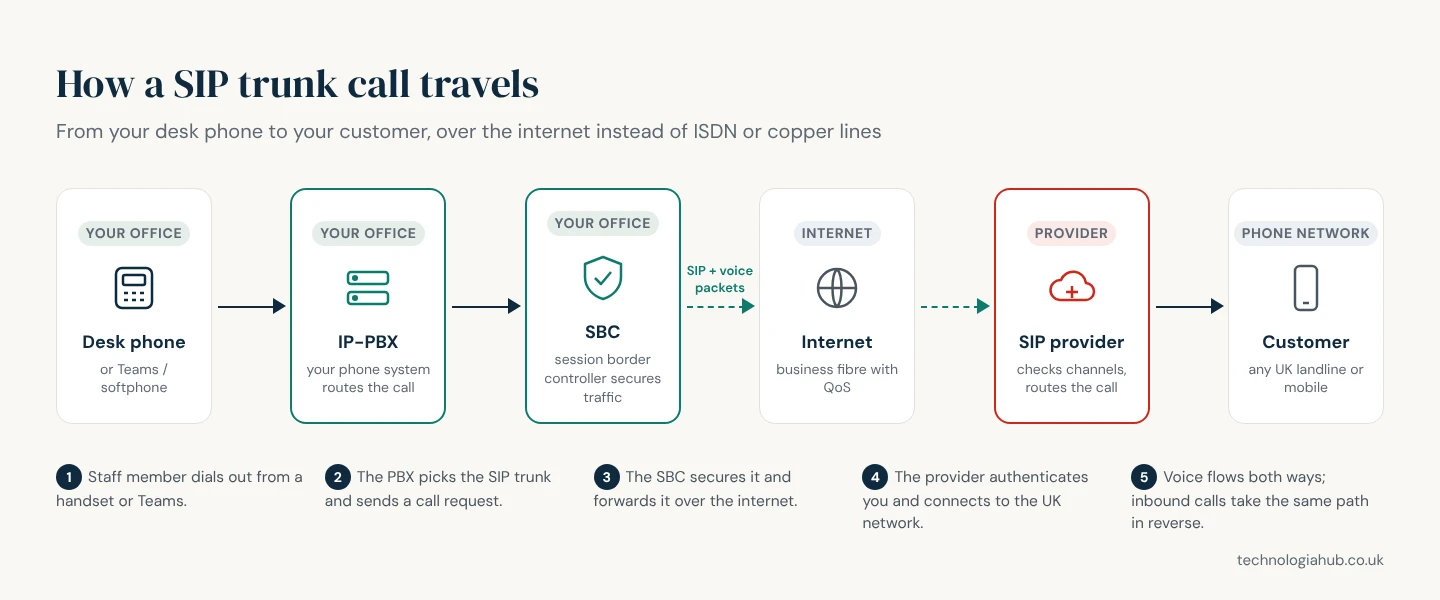
- A member of staff dials a customer from their desk phone.
- The PBX decides the call needs to go out and sends a SIP request to the SBC.
- The SBC checks the request, secures it and forwards it over the internet to your SIP provider.
- The provider authenticates your trunk, checks you have a free channel, and routes the call to the customer’s landline or mobile network.
- The customer answers. Voice travels back and forth as small data packets (RTP) for the duration of the call.
- When either side hangs up, SIP closes the session and frees the channel.
Inbound calls run the same path in reverse: someone dials your number, the provider sends the call down your trunk, and your PBX rings the right extension or IVR menu.
Using SIP with Microsoft Teams (Direct Routing)
Many UK businesses now use Microsoft Teams for calls as well as chat. Teams Direct Routing lets you connect a SIP trunk to Teams through a certified SBC, so staff can make and receive normal phone calls in Teams using your existing numbers. It’s often cheaper than Microsoft’s own Calling Plans, especially for businesses with high call volumes or many numbers, and it lets you keep your choice of SIP provider.
4. SIP Trunking UK Costs: What You’ll Actually Pay in 2026
Most provider pages quote a single per-channel price. That’s only part of the picture. Here’s the full breakdown.
Per-channel vs concurrent-call vs unlimited pricing models
- Per-channel pricing: you pay a fixed monthly fee for each channel, and calls are charged separately per minute or from a bundle. Best if your call volume is predictable.
- Concurrent-call (pay-as-you-go) pricing: you pay a small fee for the trunk and are charged per minute, with capacity scaling up as needed. Best for low or variable volumes.
- Unlimited / inclusive bundles: a higher per-channel fee that includes UK landline and mobile minutes. Best for heavy outbound callers, as long as you read the fair-use policy.
Typical monthly costs
Indicative UK prices in 2026, excluding VAT. Actual quotes vary by provider, volume and contract length.
| Item | Typical UK cost | Notes |
|---|---|---|
| SIP channel | £3–£8 per channel/month | Lower per-channel price at higher volumes |
| Inclusive-minutes channel | £8–£15 per channel/month | UK landlines and mobiles included, subject to fair use |
| Geographic number (01/02) | £0–£2 per number/month | Often a few included free |
| Non-geographic number (0800/0330/03) | £2–£10 per number/month | Plus any inbound call charges |
| UK landline calls | 0.5p–1.5p per minute | If not in a bundle |
| UK mobile calls | 1p–3p per minute | If not in a bundle |
| International calls | Varies by destination | Check rates for your top destinations |
Need extra local or national numbers for a new office or marketing campaign? UK virtual numbers can be added to a SIP trunk without any new physical lines.
One-off costs
- Session border controller or gateway: about £400–£2,500 for hardware, depending on channel count, or a monthly fee if virtual or provided as a service.
- PBX upgrade or SIP licence: £0 if your PBX already supports SIP; a few hundred pounds for a licence or software update if it doesn’t; more if the PBX needs replacing.
- Number porting: often free, sometimes £10–£50 per number or range.
- Installation and configuration: often free on a 24- or 36-month contract, otherwise typically a few hundred pounds for engineer time.
Hidden costs to budget for
- Broadband upgrade or dedicated line. If your current connection is shared with heavy internet use, you may need a faster connection or a separate voice line.
- Backup connection. A 4G/5G router or second broadband line for failover adds roughly £20–£60 per month.
- Support and maintenance. Some providers include support; others charge monthly for SBC and PBX management.
- Contract lock-in. Cheaper per-channel prices often come with 36-month terms. Check what happens if you need fewer channels later.
Worked example: SIP vs ISDN30 vs analogue lines
Scenario A: a 10-person office that peaks at 6 concurrent calls (indicative monthly costs, excluding calls)
| Option | Monthly line cost |
|---|---|
| 6 analogue PSTN lines at £20–£30 each | £120–£180 |
| ISDN2 x 3 (6 channels) at £15–£25 per channel | £90–£150 |
| SIP trunk, 6 channels at £3–£8 | £18–£48 |
Scenario B: a 50-person business that peaks at 20 concurrent calls
| Option | Monthly line cost |
|---|---|
| ISDN30, 20 channels at £15–£25 per channel | £300–£500 |
| SIP trunk, 20 channels at £3–£8 | £60–£160 |
On these numbers, SIP trunking typically saves between £1,000 and £4,000 a year for a business like Scenario B, before counting cheaper call rates. Subtract any one-off SBC cost and broadband upgrade to get your real payback period, which is usually well under a year.
Want a quote sized to your actual call volumes? Send us your current setup through our contact form and we’ll come back with a channel count and price.
5. SIP Trunking vs Traditional Lines (ISDN and PSTN): Head-to-Head
| Factor | SIP trunking | ISDN30 / ISDN2 | Analogue PSTN lines |
|---|---|---|---|
| Typical monthly cost | £3–£8 per channel | £15–£25 per channel | £20–£30 per line |
| Scaling up | Minutes to hours, done remotely | Weeks; new lines sold no longer | New lines no longer sold |
| Minimum order | 1 channel | ISDN30: usually 8 channels | 1 line |
| Resilience | Automatic failover to mobiles, other sites or backup links | Single physical route into the building | Single physical route |
| Call quality | HD voice possible; depends on connection and QoS | Consistent, narrowband | Consistent, narrowband |
| Setup time | Days to a few weeks | No longer available to order | No longer available to order |
| Numbers | Any UK area code at any site | Tied to local exchange | Tied to local exchange |
| Future | Long-term standard | Switched off by 31 Jan 2027 | Switched off by 31 Jan 2027 |
The table makes it look one-sided, and on cost, flexibility and future-proofing it largely is. ISDN’s one real strength is that it’s a dedicated physical circuit, so call quality is predictable. SIP trunking matches that on a good connection with QoS, but it can’t fix a poor one, which is why section 7 matters.
SIP trunking vs hosted VoIP: which replaces ISDN better?
Both replace ISDN. The difference is who owns the phone system:
- Choose SIP trunking if you’ve recently invested in a PBX, have in-house or partner IT support to manage it, need deep integration with on-site systems, or want to plug into Microsoft Teams Direct Routing.
- Choose hosted VoIP (cloud PBX) if your PBX is old or out of support, you don’t want to maintain hardware, your team works remotely, or you’d rather pay a simple per-user fee. See our cloud PBX vs on-site phone system comparison for a deeper look.
6. When SIP Trunking Beats a Traditional Line
Here are the situations where SIP trunking UK services clearly outperform ISDN and analogue lines.
You already have a modern PBX you want to keep
If you’ve spent thousands on a phone system in the last few years, SIP trunking lets you keep it. Your users keep the same handsets, extensions and voicemail, and only the lines behind the system change. This is the single biggest reason businesses choose SIP over hosted VoIP.
You make or take a lot of calls
For sales teams, support desks and contact centres, the economics are clear: cheaper channels, cheaper call rates and the ability to add capacity in minutes for seasonal peaks or campaigns. If high-volume calling is core to your business, pair your trunk with a cloud contact centre or an auto dialler to get far more out of every channel.
You run multiple sites or hybrid teams
With ISDN, every office needs its own lines. With SIP, one centralised trunk can serve all your sites, calls between offices are free, and channels are shared across the business, so you buy for your total peak rather than each site’s peak.
You need disaster recovery and call rerouting
If an ISDN line is cut, your phones go dead until an engineer fixes it. With SIP, if your office loses power or internet, your provider can automatically reroute calls to mobiles, another site or voicemail within seconds. For businesses where a missed call is a lost sale, that alone justifies the switch.
You want local, national or international numbers without new lines
SIP lets you hold a Manchester number in a London office, add an 0800 number for a campaign, or present a local number in another country, all on the same trunk, without new physical lines. If you’re unsure which prefix suits you, see 01, 02, 03 or 0800: choosing the right UK business number.
7. When SIP Trunking Isn’t the Right Choice
SIP trunking is the right answer for many businesses, but not all of them. Be honest about these situations before you sign a 36-month contract.
Your broadband is poor or unreliable
SIP trunking is only as good as the internet connection under it. If your site has slow upload speeds, frequent drop-outs, or no option for fibre, call quality will suffer. Fix the connection first, or consider a mobile-first or hosted solution with built-in failover.
You’re a very small business (1–3 users)
A SIP trunk needs a PBX to plug into. If you’re a sole trader or a tiny team without a phone system, buying a PBX and SBC just to use SIP rarely makes sense. A simple hosted VoIP phone system or a digital voice line from your broadband provider will be cheaper and easier.
You rely on legacy alarms, lifts, payment terminals or fax machines
Burglar alarms, fire panels, lift emergency lines, older card terminals, franking machines and fax machines often depend on analogue signalling. Some work through an analogue telephone adapter (ATA) on a SIP line, but many don’t work reliably, and some safety-critical ones should move to a dedicated 4G/IP solution instead. Audit these before you migrate.
Your PBX is old and can’t be upgraded cost-effectively
If your phone system is 10–15 years old, out of manufacturer support, and would need new cards, licences and a gateway to talk SIP, you’ll be spending money to keep a system that’s nearing the end of its life. In that case, moving straight to a cloud phone system is usually better value than SIP-enabling old hardware. Our plain-English guide explains what a cloud PBX is and how it differs from an on-site system.
8. What You Need Before You Switch (Setup Requirements)
Bandwidth: how much do you need?
Each call uses bandwidth in both directions. As a working guide:
- G.711 codec (standard UK quality): about 100 kbps per concurrent call, upload and download
- G.729 codec (compressed): about 30–40 kbps per concurrent call
So 10 concurrent calls on G.711 need roughly 1 Mbps of dedicated upload and download headroom. That sounds small, but voice is sensitive to jitter (uneven packet timing) and packet loss, not just speed. A connection that’s congested by video calls and file uploads will cause choppy audio even if the headline speed looks fine.
A SIP-compatible PBX, or a gateway for legacy kit
Check with your PBX maintainer whether your system supports SIP natively and what licences you need. If it only has ISDN or analogue ports, an ISDN-to-SIP gateway or ATA will bridge the gap.
Quality of Service (QoS) and firewall/NAT configuration
- QoS tells your router to prioritise voice packets over other traffic.
- Firewall and NAT settings must allow SIP signalling and RTP audio through to your SBC. Getting this wrong is the main cause of one-way audio and dropped calls.
- Disable SIP ALG on your router. This feature is meant to help SIP but often breaks it.
Security: preventing toll fraud and SIP attacks
SIP systems exposed to the internet are a target for toll fraud: criminals hijacking your trunk to make expensive international calls, often overnight or at weekends. Protect yourself with:
- An SBC, or provider-side protection, that only accepts traffic from your provider’s IP addresses
- Strong, unique passwords on every extension and admin account
- International call barring on numbers that don’t need it
- Spend limits and fraud alerts from your provider
Emergency calls (999/112) and location data
UK providers must give access to emergency services. Because SIP isn’t tied to a physical address, make sure your provider has the correct registered address for every site and number, so emergency services are sent to the right place.
9. How to Set Up SIP Trunking: Step-by-Step
1. Audit your current lines, numbers and kit.
List every phone number, ISDN or analogue line, and device that uses a line (including alarms, lifts and card terminals). Get your latest phone bill, as it shows what’s on your account.
2. Work out how many concurrent calls you need.
Look at your PBX call reports or your bill for peak-hour usage. Add 10–20% headroom for busy days. If you don’t have data, a rough starting point is one channel for every 3–4 office staff, or one per agent in a call centre.
3. Check and upgrade your connectivity.
Run a VoIP quality test (jitter, latency, packet loss) at busy times. Upgrade or add a dedicated voice connection if needed, and arrange a backup link.
4. Choose a provider.
Use the checklist in section 10. Ask for a trial trunk to test call quality before you commit.
5. Port your existing numbers.
Your new provider requests the port from your current one. Single numbers usually move in a week or two; multi-line ISDN number ranges can take longer, so start early. Our guide to moving your business phones to the cloud explains how UK number porting works in more detail.
6. Configure the PBX and SBC, then test.
Set up the trunk on your PBX, configure the SBC, QoS and firewall, and test inbound, outbound, transfers, hunt groups, voicemail, 999 address data and call recording if you use it.
7. Go live with a fallback plan.
Schedule the port for a quiet time, keep your old lines active until the port completes, and set up failover routing so calls divert to mobiles if anything goes wrong on day one.
10. How to Choose a SIP Trunk Provider in the UK
There are dozens of SIP trunking UK providers, from national carriers to small resellers, and the cheapest per-channel price rarely tells you the full story. Use this checklist to compare them like for like.
Provider checklist
- UK network and Ofcom-regulated: they operate under Ofcom’s General Conditions, including number porting and emergency call obligations.
- Uptime SLA: look for 99.95% or better, with service credits if they miss it.
- UK-based support: with real engineers, available during your business hours or 24/7 if you need it.
- Failover and resilience: automatic rerouting to mobiles, other sites or backup trunks.
- PBX compatibility: certified or tested with your PBX brand and with Teams Direct Routing if relevant.
- Number porting: a clear process and timescales, ideally handled for you.
- Fraud protection: spend caps, alerts and international barring.
- Transparent pricing: channel fees, call rates, number fees and one-off costs in writing.
- Flexible contract: the ability to add or remove channels without penalty.
Questions to ask before signing
- What exactly is included in the per-channel price?
- What happens to my calls if my internet connection fails?
- How long will porting my numbers take, and who manages it?
- Do you supply and manage the SBC, or do I need my own?
- What fraud protection do you provide, and who pays if fraud happens?
- Can I reduce channels during the contract if my needs change?
- Can I trial the service before committing?
At Technologiahub, our SIP trunking service for UK businesses is sized to your real call volumes, with UK numbers, failover routing and porting handled for you.
11. Common SIP Trunking Problems and How to Avoid Them
One-way audio, jitter and dropped calls
- One-way audio is almost always a firewall/NAT issue or SIP ALG interfering. Disable SIP ALG and open the correct RTP port range.
- Jitter and choppy audio come from congested or unstable connections. Apply QoS, or separate voice onto its own connection.
- Calls dropping after a set time (often 30 seconds or 15 minutes) usually indicate session timer or NAT keep-alive settings that need adjusting.
Number porting delays
Ports fail when details don’t match exactly: account holder name, installation address, postcode or the full list of numbers on the line. Get a recent bill, confirm every number in your ranges, and don’t cancel your old service until the port has completed. For the full process, read how to port your UK business number without downtime.
Overspending on channels you don’t use
Businesses often buy one channel per employee “to be safe”. Size against concurrent calls, review usage after three months, and choose a provider that lets you scale down. It’s also worth connecting your phone system to your CRM so you can see actual call patterns rather than guessing.
12. Frequently Asked Questions
How much does SIP trunking cost in the UK?
Most UK businesses pay around £3–£8 per SIP channel per month, plus call charges, or £8–£15 per channel with inclusive minutes. One-off costs such as a session border controller (£400–£2,500) and any PBX licences come on top, though setup is often free on longer contracts.
Can I keep my existing phone numbers?
Yes. Almost all UK geographic and non-geographic numbers can be ported to a SIP trunk. Your new provider handles the request, and single numbers typically move within a week or two. ISDN multi-number ranges can take longer.
What happens to my SIP trunk if the internet goes down?
A well-configured SIP trunk fails over automatically. Calls can be rerouted to mobiles, another office, a backup internet connection or voicemail, so customers still get through. Ask your provider to set this up before go-live.
Do I need to replace my phone system?
Usually not. Most phone systems from the last decade support SIP natively or with a licence upgrade. Older ISDN-only systems can connect through a gateway, though if the system is out of support, moving to a cloud phone system may be better value.
How many SIP channels do I need?
You need one channel per simultaneous call at your busiest time, plus 10–20% headroom. Check your PBX reports or phone bill for peak usage. As a rough guide, offices need one channel per 3–4 staff, and call centres need one per agent.
Is SIP trunking secure?
It is when set up correctly. Use a session border controller, restrict traffic to your provider’s IP addresses, use strong passwords, bar international calls you don’t need, and set spending limits to protect against toll fraud.
What’s the difference between SIP trunking and VoIP?
VoIP is any voice carried over the internet. SIP trunking is a specific type of VoIP that connects a phone system you own to the phone network. Hosted VoIP is the other main type, where the provider runs the phone system for you.
Will my ISDN line stop working after January 2027?
Openreach has confirmed 31 January 2027 as the final date for migrating off PSTN and ISDN. Lines left behind may be moved to a temporary emergency-only service or ceased, so businesses should migrate well before the deadline.
13. Conclusion: Is SIP Trunking Right for Your Business?
SIP trunking beats a traditional line for most UK businesses that already own a capable phone system: it’s cheaper per channel, scales in minutes, survives outages better, and won’t be switched off in January 2027. It’s the wrong choice if your internet connection is poor, your PBX is at the end of its life, or you’re a very small team that would be better served by a simple hosted system.
Getting SIP trunking UK pricing right comes down to sizing, not headline rates. The quickest way to find out which side of that line you’re on is to look at your numbers: your current lines, your peak concurrent calls, and your connection.